

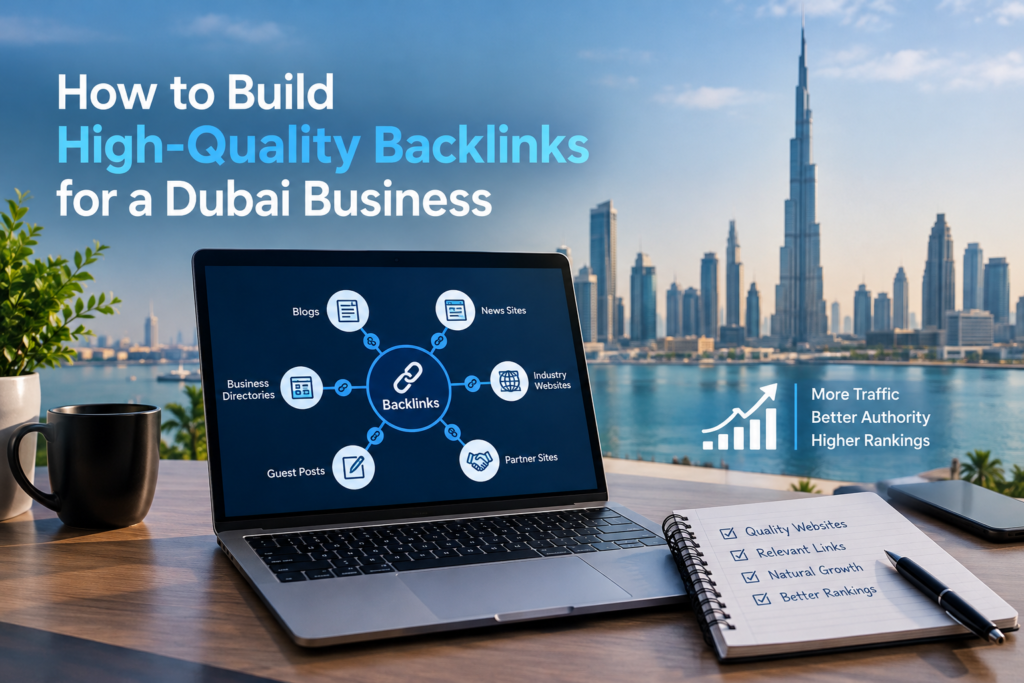
Picture a Dubai clinic, law firm or property consultancy with a tidy service page, quick load times and sensible keywords. It still sits on page two, while a competitor with a thinner page holds third place. When that happens, the difference is usually outside the website: the competitor is quoted, mentioned and linked to by more credible sites.
Backlinks are the most direct part of that outside picture, and the part of off-page SEO in Dubai that is most often done badly. This guide explains what makes a link worth having in the UAE, where those links come from, how to approach the sites that can give them, and which shortcuts to leave alone. Everything here can be done in-house. If you would rather hand it to specialists, our off-page SEO services in Dubai cover the same ground.
What makes a backlink high quality?
Authority scores from SEO tools are a rough guide at best. Four plain questions tell you more about whether a link is worth the effort.
- Is the site relevant to your business? A link from a Dubai healthcare publication means more to a dental clinic than a link from a general site with no connection to health.
- Does it have real editorial standards? If anyone can publish there for a fee, a link from it says very little about you.
- Does it reach people you want to reach? Readers in the UAE and the wider region, in the sectors you sell to. A link that sends nobody to your site is a weaker signal than one that does.
- Is the link placed in context? A link inside a sentence of a relevant article beats one tucked into a footer, a sidebar or a long list of “partners”.
Use metrics such as domain rating to filter out obvious junk, not to make the final call. A handful of links that pass all four questions are generally worth more than a long list that passes none.
Give people a reason to link before you ask
Nobody links to a homepage because a business exists. They link to something useful: a clear explanation, a figure they can cite, a tool they can send to a reader. Before any outreach, decide which pages deserve to be linked to.
For UAE businesses, workable ideas include a plain-language guide to a process your customers find confusing, written by someone who has actually handled it; a calculator or checklist that saves readers time; or a short report built on data you already hold, such as anonymised enquiry patterns. Only publish figures you can stand behind, and say how they were gathered.
Those pages also need to be ready to receive links. If they are slow, hard to crawl or poorly targeted, the authority they attract is partly wasted, so sort out the basics from your technical SEO and on-page SEO work first or alongside.
Six places to earn links in the UAE
Good off-site SEO strategies in the UAE depend on knowing which sources your customers actually read. These are the routes worth trying first, roughly in order of how much they reward effort over money.
Press coverage and expert comment
Business and sector media in the UAE regularly need someone who can explain a regulation change, a market shift or a trend. Prepare a short biography, a list of topics you can speak on, and a named spokesperson who can reply within hours, because journalists work to tight deadlines. Newsworthy moments include product launches, new research, Ramadan campaigns, and the large trade events held in Dubai through the year.
Guest articles on industry sites
A pitch that says “can I write a guest post?” rarely gets answered. A pitch that names a specific idea, shows why that site’s readers would want it and includes two or three sample headlines often does. Write the article for their audience, not as an advert for yours, and add a link only where it helps the reader. A strong writer on your content SEO side makes this much easier.
Business communities, trade bodies and events
Chambers, industry associations, free zone communities and event organisers often publish member profiles, partner pages and speaker listings that link to the businesses involved. These links are valuable because they come with real-world standing. Pursue them only where you genuinely belong. A membership you do not hold, or a sponsor page you did not earn, is not a link worth chasing.
Unlinked brand mentions
Search for your company name, your founder’s name and your product names. Where a site already mentions you without linking, a short, friendly email asking for a link to the relevant page is one of the easiest requests you will make, because the site has already decided you are worth writing about.
Competitor link gaps
List the three or four businesses ranking above you, then find the sites that link to them but not to you. Do not copy their links. Look at why each site linked, whether it was a guide, a quote or an event, and ask whether you can offer something equally useful. A backlink analysis tool speeds this up, but the judgement about which gaps are worth closing is yours.
Arabic-language and regional publications
Dubai searches come from a mixed audience, and many readers choose Arabic-language outlets. Coverage there reaches people your English-language press never will, and it signals regional relevance. Have the material written or reviewed by a native Arabic writer rather than machine-translated, because poor copy damages the very credibility you are trying to build.
Reviews and business listings sit beside all of this. They rarely carry much link value on their own, but accurate details and genuine customer reviews support trust, particularly where location drives enquiries. That work belongs with your local SEO plan rather than your link-building plan.
Outreach that gets a reply
Outreach fails mostly because it is generic. A few habits make a visible difference.
- Choose fewer, better targets. Twenty well-matched sites you have actually read beat two hundred scraped from a list.
- Read their recent work first. Mention a real article of theirs and explain how your idea fits what they already cover.
- Keep the first email short. One clear idea, why their readers would care, and what you can provide. Avoid attachments in the first message.
- Follow up once. A single polite reminder after about a week is reasonable. Repeated chasing is not.
- Say thank you and keep the relationship. Editors remember people who were easy to work with, and the second placement is usually easier than the first.
Shortcuts that put your site at risk
Google’s spam policies treat links created mainly to manipulate rankings as link spam, including buying or selling links that pass ranking credit, excessive link exchanges and automated link creation. Sites caught doing this can lose rankings.
In practice, that means being wary of marketplace listings that promise hundreds of “high-authority” backlinks for a small fee, private blog networks, mass directory submissions and bulk placements on sites that accept anything. If you do pay for a placement, such as sponsored content, make sure it is disclosed with rel=“sponsored” and do not treat it as the foundation of your strategy.
Anchor text is another quiet risk. If most of your links use the exact phrase you want to rank for, the pattern looks engineered. Let anchors vary naturally, using your brand name, the page topic or a plain description of the page.
How to tell whether it is working
Counting links tells you little. Track outcomes that connect to the business:
- New referring domains, and how relevant each one is to your sector
- Rankings and visibility for the specific pages you are supporting
- Referral traffic from the placements you secured
- Growth in searches for your brand name
- Enquiries and leads from organic search
Keep a simple log for every link: the linking URL, the date, the page it points to, the anchor text and how you earned it. It makes later reviews far easier and gives you a clean record if you ever need to audit your links.
Be patient. New links can take weeks to be recognised, and competitive Dubai searches often need several months to move. The timeline depends on your starting authority and on how strong the businesses above you are.
When it makes sense to bring in a specialist
Doing this yourself works if you have time for outreach, content to offer and the patience to build relationships. It gets harder when several people are involved, when your sector is crowded, or when you do not know which of your existing links are helping or hurting. That is where an off-page SEO agency in Dubai earns its fee.
Whoever you choose, ask which sites they will approach and why, how each placement is checked before it counts, and what they will report on. Be cautious of any provider that sells a fixed number of links for a flat fee without naming the sites. Link quality, not link count, is what matters.
If you want to see where you stand first, request a free backlink review through our off-page SEO service page. For a wider look at your whole website, our SEO audit in Dubai covers technical, on-page and content issues too.