

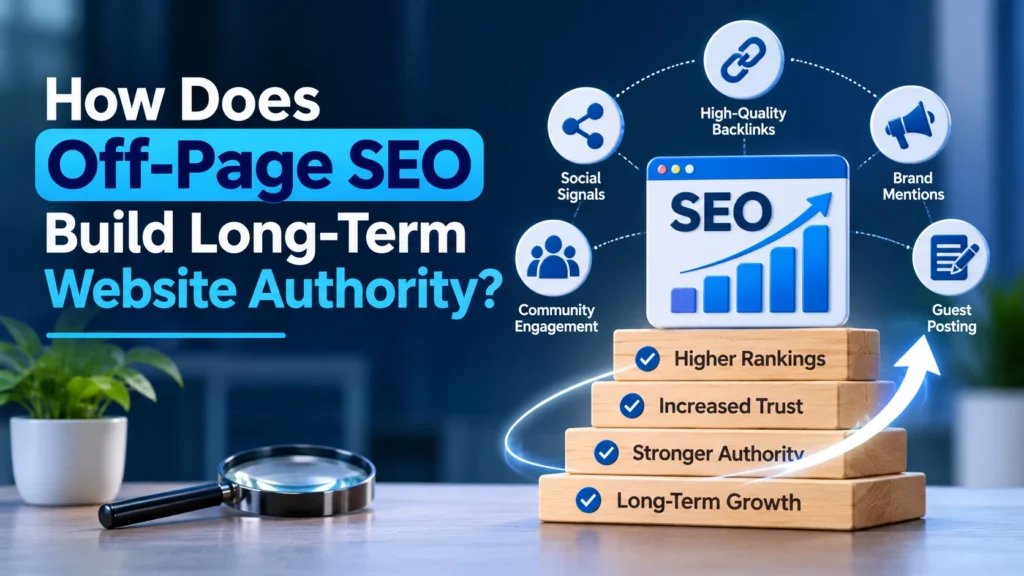
Off-page SEO builds long-term authority by gathering independent evidence about your website: links from relevant sites, mentions of your brand in places your audience actually reads, and reviews and listings that confirm you are who you claim to be. Each piece of evidence is small. Together they accumulate, they are slow for a competitor to copy, and they keep working after the campaign that earned them has finished.
That is the short answer. The longer one is more useful, because authority is not a score you can buy. This article explains what authority really is, the four ways external signals compound, why the process is slow on purpose, what Google has said about links, how brand mentions now influence AI-generated answers, and how to tell whether yours is growing.
Authority is a judgement other people make about you
Anyone can write “we are experts” on their own website. Nobody takes that sentence as proof, in the same way a CV is not proof until someone you trust vouches for the person behind it. Search engines face exactly this problem at enormous scale. Every site claims to be the best answer, so they look outward for confirmation: who links to this page, who names this company, what do independent sources say about it?
That outward evidence is what off-page SEO produces. It sits alongside on-page SEO, which makes your pages relevant and understandable, and technical SEO, which makes them crawlable. Those two decide whether a page deserves to rank. Off-page signals help decide whether it is believed.
A quick note on terminology. Domain Authority is a metric created by Moz, and Domain Rating belongs to Ahrefs. Both are outside estimates of how strong a site’s link profile looks, and both are handy for comparing yourself with competitors. Neither is a Google signal. Treat them as a model of Google, not as Google.
Four ways off-page work compounds over time
1. Links keep working after the work stops
A link placed editorially inside a published article continues to pass relevance and send visitors for as long as that page stays live. Paid advertising stops the day the budget stops. A well-earned link from a respected publication can still be doing its job years later. The caveat is that pages are deleted, moved and redesigned, so link equity is durable rather than permanent. More on that further down.
2. Relevance builds up
Ten links from sites in your own field say more than a hundred from unrelated ones. Over time the context around your links, including the topic of the linking page, the words used to describe you and the audience reading it, teaches search engines what your business is about. A Dubai physiotherapy clinic cited by sports-medicine writers and health publications is building a clearer identity than one with a scattering of links from general directories.
3. People start to recognise your name
Someone who has met your brand in a trade article, a podcast and a news comment is far more likely to search for it later. Branded search is visible in Google Search Console, and it is one of the cleaner signs that awareness is turning into demand. It is also a signal that other people care enough about your company to look for it by name.
4. Independent sources corroborate each other
Consistent business details across listings, genuine customer reviews, membership of a recognised chamber or trade body, and accurate descriptions in third-party profiles all point the same way. Trust grows when several unconnected sources agree. This matters most in sectors where a wrong decision is costly, such as healthcare, legal services, finance and property, and where search engines tend to be more demanding about credibility.
Why it takes months, and why that protects you
There is no honest fixed timeline for off-page SEO. New links can take weeks to be recognised, and competitive searches usually take several months to respond, depending on where your site starts and how strong the pages above you are. Anyone promising a ranking on a date is guessing.
The slow pace has a useful side. In December 2022 Google announced a link spam update that uses its SpamBrain system to neutralise unnatural links, and said that credit those links had passed would be lost. In other words, authority assembled through manipulation can be cancelled without warning, and once cancelled the benefit is gone. Authority built from real references rests on things a competitor cannot simply purchase, and a spam filter has no reason to remove it. Google’s spam policies set out which link practices fall on the wrong side of that line.
What Google has said about links, and what to take from it
At PubCon Pro in 2023, Google’s Gary Illyes said links had not been among Google’s top three ranking factors for some time and that people tend to overestimate their importance, as Search Engine Land reported. He did not say links are unimportant, and he added that it is possible to rank without them. In 2024 Search Engine Journal reported a further remark from Illyes that Google needs very few links to rank pages.
The sensible conclusion is not that off-page SEO is dead. It is that link volume is the wrong target. A small number of relevant, editorially earned links, backed by real brand visibility, does more than a large pile of weak ones. And in a competitive category you are usually competing against sites with strong external profiles, so being absent from the conversation is a handicap even if links are not the single biggest factor.
Off-page SEO and AI search
More searches now end in an AI-written answer, so it is worth asking what makes a brand appear in one. The best public evidence so far comes from an Ahrefs study of 75,000 brands. It found that how often a brand is mentioned across the web had the strongest correlation with its appearance in Google AI Overviews, at 0.664. Branded anchor text scored 0.527 and branded search volume 0.392. Traditional backlinks scored 0.218.
Two cautions belong with those numbers. First, they are correlations, and Ahrefs itself says correlation is not causation. Second, the study looked at established domains and left out brands with no AI Overview mentions at all, so it does not tell a brand-new business what will work for it. Later Ahrefs analysis extended the work to ChatGPT and Google’s AI Mode, with mentions again prominent, but nobody can honestly promise that any tactic will place you in an AI answer.
The practical reading is still clear. Language models learn what a company is from how others describe it. A sentence in an independent article that says your firm specialises in a particular service teaches them more than a claim on your own homepage. Long-term authority is increasingly brand authority: being named, and described accurately, by credible sources, whether or not a clickable link comes with it.
Which signals build which kind of authority
Different off-page activities strengthen different things. This table is a working guide, not a ranking of importance.
| Signal | What it contributes | How long it lasts | How to check it |
|---|---|---|---|
| Editorial backlinks | Relevance, referral visits, a reference search engines can follow | As long as the linking page stays live | Referring domains report; relevance of each linking site |
| Press and digital PR coverage | Brand awareness, credible mentions, often links | Strong at publication, then a long tail | Mentions tracking; branded search in Search Console |
| Unlinked brand mentions | Entity recognition; useful for AI answers | Depends on the source | Brand monitoring tools; manual searches of your name |
| Reviews and business listings | Corroboration and local trust | Needs ongoing upkeep | Consistency audit of name, address and phone details |
| Expert contributions (podcasts, panels, commentary) | Personal authority attached to the brand | Long, if the page or recording stays up | Speaker and show-notes pages; referral traffic |
| Original data and research | A reason for others to cite you repeatedly | Can last for years if kept current | Citations over time; links to the research page |
What this looks like in Dubai
The mechanism is the same everywhere, but the local conditions shape the work. Searches in the emirate come from residents, investors, expatriates and visitors, in both English and Arabic. It is worth checking whether competitors have coverage in a language you lack. The sources your buyers trust also differ by sector: a property investor and a patient read very different things.
Useful starting points include UAE and regional business publications, trade and industry sites, chambers and professional associations you genuinely belong to, and events where your people speak. If you work in a regulated profession, keep outreach factual and inside what your licensing body permits. Where location drives your enquiries, accurate listings and real reviews support your wider local SEO.
Four questions to answer before any outreach
- Which pages deserve support? Choose the pages that earn revenue. Links pointing to a page with thin content or crawl problems are wasted, which is why on-page and technical fixes often come first.
- Who already mentions you without linking? People who have named you once are the warmest outreach you will ever have. Asking for a link where a mention already exists is a small request.
- Where do competitors earn links that you do not? Compare your profile with the businesses ranking above you and list the sites that cite them but not you. This gap list usually shows which kinds of publications matter in your sector.
- What do you have that is worth citing? Original data, a clear position or a quotable specialist gives people a reason to reference you. If the honest answer is nothing yet, fix that before you send a single pitch.
Habits that quietly erode authority
- Buying links from sellers who will not name the sites. If a provider will not say where your links will appear, assume you will not want to see them.
- Using the same exact-match anchor text again and again. Natural references describe you in varied ways, often just by brand name.
- Chasing a third-party score instead of relevance. A high Domain Rating on an unrelated site adds little to a business that sells to a specific audience.
- Campaigning in bursts. Competitors keep earning mentions while you pause, and old links gradually disappear.
- Ignoring links to pages that no longer exist. When a page that earned links is deleted, those links point at an error. Redirect it to the closest relevant live page and the value is largely preserved. It is one of the cheapest authority wins available.
How to tell whether authority is actually growing
Expect a lag, then look at several indicators together rather than any single number.
- The relevance and variety of new referring domains, not only their count.
- Branded search impressions and clicks in Google Search Console over several months.
- Rankings and visibility for the specific pages you set out to support.
- Referral traffic from the placements you secured.
- How often your brand is named compared with direct competitors.
- Whether AI assistants describe your business correctly when asked about your sector. Check this by hand at regular intervals and record what you find.
One pattern is worth watching for. If a third-party authority score is climbing but branded search is flat, you may be collecting links without building recognition, and the gap is worth investigating.
Frequently asked questions
Is off-page SEO a one-off project?
No. Links go stale, competitors keep earning coverage and your own news changes. Authority is maintained by steady activity, with the effort adjusted to how competitive your market is.
Do unlinked brand mentions help?
They can. A mention does not pass link equity, but it adds to how widely and consistently your brand is described, which research suggests is associated with visibility in AI answers. Converting a mention into a link by asking politely is also a low-effort win.
Can a site build authority without backlinks?
To a degree. Reviews, citations in directories that matter, brand searches and mentions all contribute. For competitive queries, though, relevant backlinks are usually still part of what separates the top results from the rest.
Does off-page SEO help a brand appear in ChatGPT and AI Overviews?
It may, because those systems draw on what the web says about a brand, and off-page work increases that. Evidence so far is correlational and no one can guarantee inclusion, so treat it as a likely benefit rather than a promise.
Where to go from here
If you would like an outside view of where your authority stands today, Solowiz offers a free review of your backlink profile as part of its off-page SEO services in Dubai. The review covers which links help, which may be doing harm, and where your competitors are earning mentions that you are missing. For a wider look at the whole site, the SEO audit is the better starting point.