

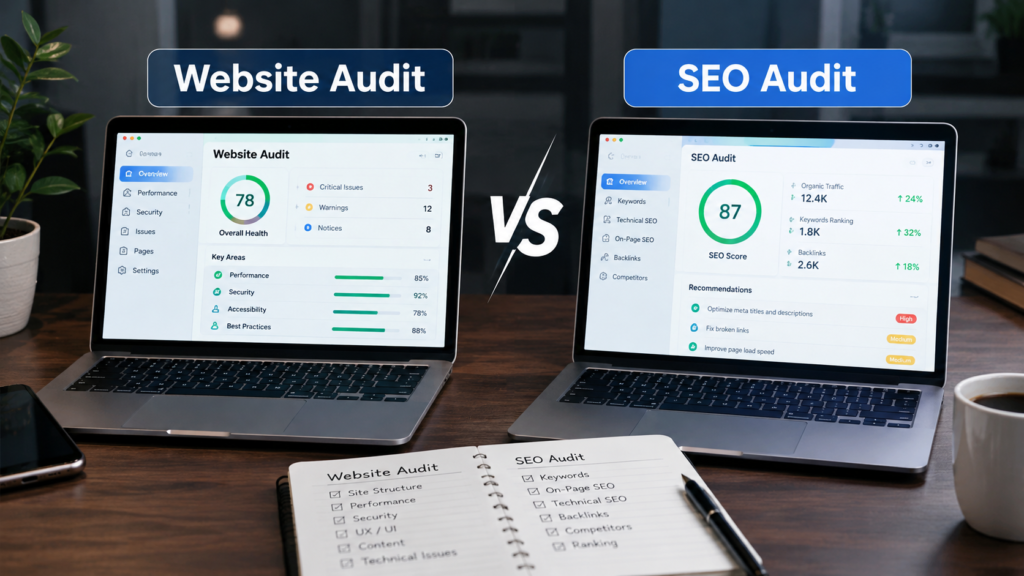
Ask three agencies for a “website audit” and you may get three different documents: a crawler export full of status codes, a critique of your design, and a keyword gap report. Ask for an “SEO audit” and the answer is not always clearer. The two terms are swapped so often that business owners end up paying for the wrong one, or for both without realising how much they overlap.
The short answer: a website audit is a health check of the whole website: design, usability, speed, security, content and conversion, with SEO as one of several lenses. An SEO audit is a focused diagnosis of everything that affects how the site performs in search. Every SEO audit looks at part of the website, but not every website audit looks closely at SEO.
This guide explains what each one covers, where they overlap, and how to decide which one your business needs first, with a few points that matter specifically if your website serves customers in Dubai and the wider UAE.
Website audit vs SEO audit at a glance
| Website audit | SEO audit | |
| Core question | Is this website working well for the people and the business using it? | Can search engines find, understand and rank this website, and how does it compare with competitors? |
| Main lens | Visitor experience and business results | Search visibility and organic traffic |
| Typical scope | Design, navigation, mobile layout, speed, security, accessibility, functionality, content, conversion paths, SEO basics | Crawling, indexing, site architecture, metadata, headings, keyword targeting, content gaps, schema, backlinks, local signals, competitors |
| Who usually does it | Developer, designer, UX specialist, marketer | SEO specialist, content strategist |
| What you get | Site-wide list of improvements across several functions | Prioritised SEO fixes and a growth plan |
| Best suited to | Redesigns, low conversion rates, usability complaints, general health checks | Traffic drops, weak rankings, poor lead flow from search, unclear SEO return |
What a website audit covers
A website audit asks whether the site does its job for visitors. It is the broader exercise, and it usually pulls in people from more than one discipline. A good one looks at:
- Usability and navigation: can a first-time visitor find what they came for in a few clicks, on a phone as well as a laptop?
- Design and consistency: layout, branding, readability and how pages behave on different screen sizes.
- Performance: how quickly pages load and respond, and whether heavy images or scripts get in the way.
- Security and trust: HTTPS, privacy and cookie notices, and anything that makes a visitor hesitate before sharing details.
- Functionality: contact forms, booking tools, checkout, payment steps and tracking tags that quietly stop working.
- Content and conversion: whether pages say what the business does, answer the questions buyers have, and lead to a clear next step.
SEO appears in a website audit too, usually as a basic pass over titles, headings, indexability and broken links. That is useful, but it is not the same depth of analysis. If you are looking for a website audit in Dubai because the site feels dated or underperforms commercially, this is the review you want. A Dubai website audit of this kind rarely stops at rankings.
What an SEO audit covers
An SEO audit narrows the question to organic search: why is this website not ranking, or not converting the traffic it gets from Google? SEO auditing in Dubai, and across the UAE, normally follows four strands.
Technical SEO
This is the foundation: whether search engines can crawl and index the right pages. It covers robots directives, XML sitemaps, canonical tags, redirects, status codes, Core Web Vitals, mobile rendering and indexing problems reported in Google Search Console. Our technical SEO service in Dubai works through this layer in detail.
On-page and content
Here the audit looks at whether each page is aimed at a clear search intent: title tags, meta descriptions, heading structure, keyword targeting, internal links, schema markup, thin or duplicated pages and keyword cannibalisation. Our on-page SEO and content SEO pages show how those findings are usually put into practice.
Off-page and competitors
A backlink review checks the quality of the sites linking to you, flags risky links and compares your profile with the businesses that already rank. Competitor benchmarking then shows which terms rivals own and where the realistic gaps are. See how off-page SEO in Dubai builds on this.
Local signals
For businesses that serve a specific area, the audit also checks Google Business Profile, citations, location pages and consistency of name, address and phone details. This is covered by a dedicated local SEO audit where it applies.
Where the two audits overlap
Four areas sit in both reports, and they are the main reason the terms get confused. In each case the same problem is read through a different lens.
- Page speed. A website audit asks whether slow pages frustrate visitors and push them away. An SEO audit asks whether the same slowness hurts Core Web Vitals and crawling. One fix, two reasons.
- Mobile experience. The website audit checks whether someone can read, tap and complete a form on a phone. The SEO audit checks that the mobile version carries the same content, because Google indexes what the mobile page shows.
- Site structure. For a website audit, structure is navigation and findability. For an SEO audit, it is crawl paths, internal links and how authority flows between pages.
- Content. A website audit asks whether it is clear and persuasive. An SEO audit asks whether it matches search intent, duplicates another page or competes for the right terms.
Because of this, a good audit of either kind will occasionally flag issues that belong to the other, and that is normal. What differs is the yardstick: a website audit measures against experience and business goals, while a website SEO audit, in Dubai or anywhere else in the UAE, measures against search visibility and organic performance.
Which audit does your business need first?
Start from the symptom rather than the label:
- Traffic has dropped, or the site is not ranking for terms you care about: start with an SEO audit. The cause is most often crawling, indexing, targeting or competition, none of which a design review will find.
- Visitors arrive but few enquire or buy: start with a website audit, particularly the UX and conversion side. Ranking higher will not fix a checkout or contact form that loses people.
- You are planning a redesign or migration: use both. A website audit defines what the new site needs to do better; an SEO audit before launch records what currently ranks so the move does not erase it.
- You have just launched a new website: a combined review catches broken functionality and indexing problems while they are cheap to fix.
- You run an online store: ask for an ecommerce-specific SEO audit that covers product pages, category structure and faceted navigation, not a generic site check.
- You are paying for SEO but cannot see a return: an independent SEO audit shows whether the work is aimed at the right pages and terms.
What a Dubai website audit or SEO audit should not skip
The checklist is similar everywhere, but a handful of points carry more weight in an SEO audit for the UAE market.
- Arabic and English versions. If the site runs in both languages, each version needs its own crawlable URL, correct hreflang annotations and a properly rendered right-to-left layout. The website audit will catch the layout glitch; the SEO audit will catch the conflicting language tags that make Google show the wrong version to the wrong searcher.
- Local and “near me” intent. Searches that include Dubai, an area name or “near me” bring Google Business Profile, citations and location pages into scope.
- Platform quirks. WordPress themes and plugins, and Shopify apps, each create their own duplicate-URL and speed problems. Our pages on WordPress SEO in Dubai and Shopify SEO in Dubai cover the usual ones.
- Competitor context. In busy sectors such as real estate, healthcare and ecommerce, knowing which terms competitors already hold matters as much as fixing your own errors. A tool score cannot show you that.
How to tell a useful audit from a tool export
Many reports sold as an audit are an automated crawl exported to PDF. The tool output is a starting point, not the deliverable. When you are comparing Dubai SEO audit services, or SEO auditing in the UAE more widely, look for:
- Issues grouped by priority, with an explanation of which ones actually affect traffic or revenue and which are cosmetic.
- Evidence for each finding: affected URLs, screenshots or Search Console data rather than a bare score.
- Specific fix instructions and a suggested owner, such as developer, content writer or marketer.
- Competitor comparison, so you can see where the opportunity sits.
- No promise of guaranteed rankings. An audit finds and prioritises problems; results depend on implementation, competition and time.
How Solowiz approaches an SEO audit in Dubai
At Solowiz, our SEO audit service in Dubai is built around the SEO side of this comparison, with UX and conversion issues flagged where they surface. The process runs in six stages:
- Technical SEO analysis: crawl, indexing and site architecture.
- On-page SEO review: keyword usage, metadata, content structure and search intent alignment.
- Content audit: quality, duplicate pages, low-engagement pages and missing keyword opportunities.
- Backlink analysis: authority, risky links and competitor backlinks.
- Competitor benchmarking against top-ranking businesses in Dubai.
- Action plan: priority fixes, growth opportunities and a step-by-step implementation plan.
Depending on the size of the website, an audit typically takes three to seven days, and we suggest repeating it every three to six months, and after any redesign, migration or sudden traffic drop. If you want the broader picture first, our SEO services in Dubai page shows where an audit fits alongside ongoing optimisation.
Frequently asked questions
Is an SEO audit part of a website audit?
Partly. Many website audits include a short SEO section, but a full SEO audit goes much deeper into crawling, indexing, keywords, backlinks and competitors than a general website review does. It is better to think of the SEO audit as a specialist component than as a replacement for the wider review.
Which should I do first?
Go by the problem. If the issue is visibility in Google, start with the SEO audit. If traffic is fine but enquiries are weak, start with the website audit. Before a redesign or migration, do both.
How long does an SEO audit take?
For Solowiz audits, usually three to seven days depending on website size. Larger sites with many templates, languages or products take longer, wherever the audit is done.
Can I run an audit myself with free tools?
Partly. Google Search Console shows indexing and performance data, and PageSpeed Insights reports on speed and Core Web Vitals. Both are free. The harder part is interpreting the results, prioritising them and adding backlink and competitor analysis, which usually needs specialist time and paid tools.
Does an SEO audit guarantee higher rankings?
No. An audit identifies what is holding the site back and the order in which to fix it. Rankings depend on how well the fixes are implemented, how strong the competition is, and how much authority the site has.
Not sure which audit you need?
If you cannot tell from the symptoms, tell us what the website is meant to achieve and what is not happening. We will say whether an SEO audit, a broader website review or both is the sensible starting point. You can request an SEO audit service in Dubai or contact the team directly.